Contractor Website - 9 Must-haves for More Orders
Learn which 9 elements a contractor website needs to generate more inquiries - from a clear entry point to measurability.
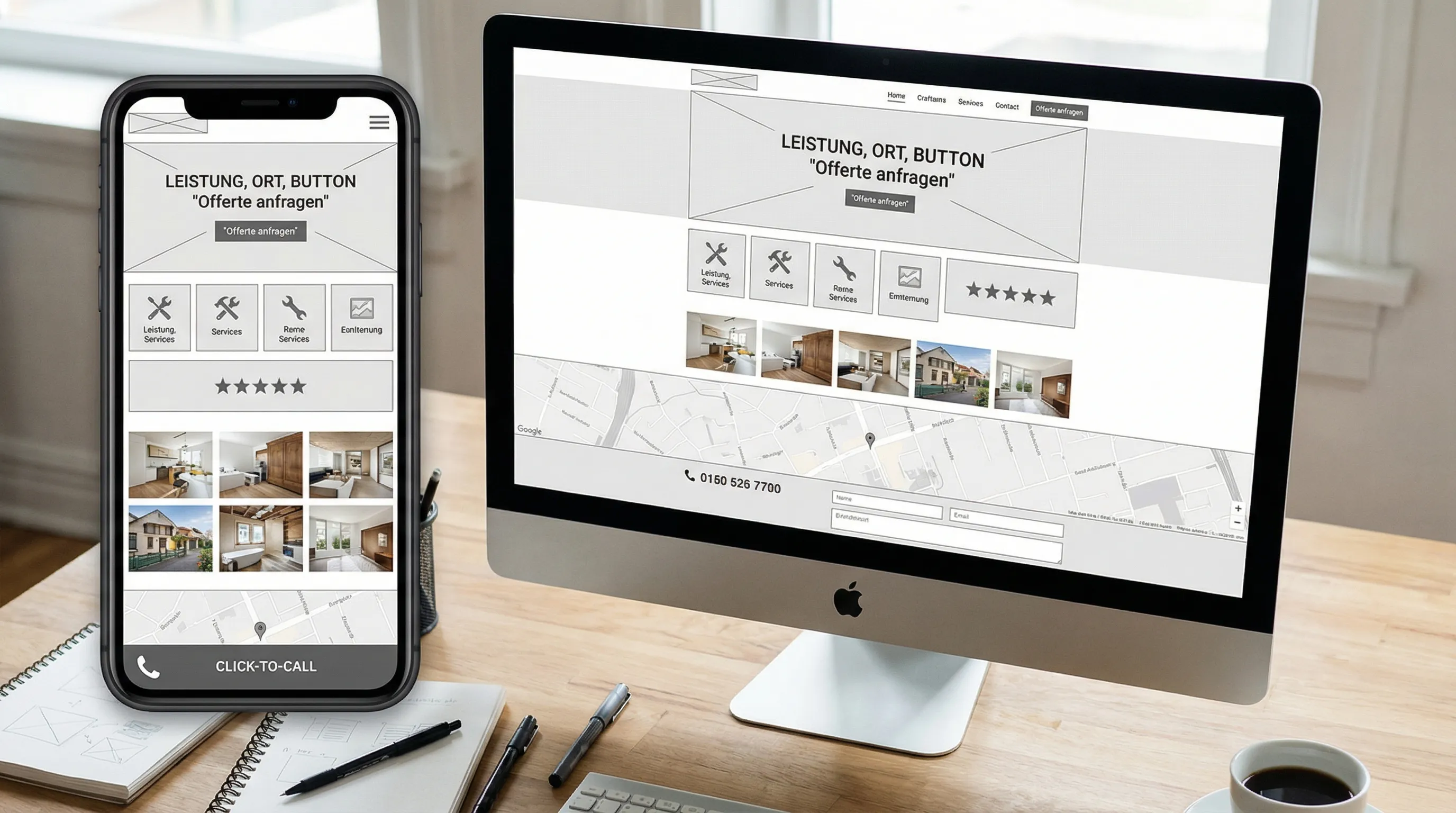
Many contractor businesses rely on referrals. This works until it doesn’t: seasonal gaps, fewer walk-in customers, new competition, or simply the desire to acquire orders more predictably. That’s exactly when your website often decides whether a prospect calls you or clicks through to the next business.
A good contractor website isn’t an online flyer, but a digital sales representative: It shows in seconds what you offer, where you work, why you can be trusted, and how to reach you without friction.
Why a Contractor Website Now Determines Inquiries
Prospects search locally, compare quickly, and often decide on the go via smartphone. If your site loads slowly, is unclear, or doesn’t enable direct contact, you lose inquiries before a conversation even begins.
What’s important isn’t having as many subpages as possible. For many trades, a very strong one-page website is sufficient, as long as it contains the right elements and is cleanly optimized for local search.
One-Page or Multiple Pages: What Works for Contractors?
A one-page website is particularly well-suited when:
- You have a clear core offering (e.g., plumbing, electrical, painting, landscaping, moving, flooring).
- Your service area is regional (e.g., a canton, a region, or multiple towns).
- You want quick inquiries via phone or form.
Multiple pages make sense if you cover many services with different search intents (e.g., heating renovation, heat pumps, service, emergency, industrial) or if content marketing (guide articles) will become a main channel.
For more orders, what counts in both cases is: clarity, trust, speed, and local discoverability.
Contractor Website: 9 Must-haves for More Orders
Must-have 1: A Crystal-Clear Entry (Service + Region + Call-to-Action)
The first 5 to 10 seconds are decisive. In the visible start area (without scrolling) there should be:
- What you do (specific, not “services”).
- Where you work (city, region, canton).
- What the next step is (e.g., “Request quote” or “Call now”).
Practical tip: Phrase it like your customers search, e.g., “Electrician in Winterthur” or “Plastering work in Lucerne and surroundings.”
Must-have 2: Mobile-First UX with “Click-to-Call”
For contractors, a large portion of inquiries come via mobile. Therefore, the site should not just “work” on smartphones, but be built for mobile use:
- Phone number clickable (click-to-call).
- Contact button always easily accessible.
- Forms short and easy to use.
If you use WhatsApp or a similar channel, an additional “Send message” button can be useful. What matters is that the contact method fits your daily routine.
Must-have 3: Fast Loading Time (Otherwise Prospects Leave)
Speed is conversion. Google measurably evaluates how fast and stable a page loads with Core Web Vitals.
User behavior also shows clear signals: Many users leave a mobile page if it takes too long to load (often cited benchmark: bounce rate increases significantly after 3 seconds).
What helps most in practice:
- Properly compress images and deliver them in modern formats.
- No unnecessary plugins and scripts.
- Clean hosting and consistent caching.
Must-have 4: Local SEO Signals (So You’re Found in Your Region)
For contractor businesses, local discoverability is often more important than “general SEO.” Your website should therefore contain clear local signals:
- Service area and locations clearly stated (not hidden in the footer).
- Address and contact details consistent (name, address, phone).
- Link to your Google Business Profile.
Additionally helpful:
- Embedded map (when appropriate).
- Structured data (LocalBusiness) so search engines understand the data better.
Must-have 5: Building Trust Through Evidence (Not Claims)
“Reliable, clean, fair” - many write this. What convinces are proofs:
- Customer reviews (e.g., Google Reviews, locally known platforms).
- Project photos before and after.
- References (brief, concrete, ideally with location/industry).
- Certificates, memberships, permits (only genuine and current).
Tip: A real photo of the team or owner often creates more trust than perfect stock images.
Must-have 6: Service Blocks That Anticipate Customer Questions
Many websites list services like a catalog. Better: Each service answers the typical questions in the prospect’s mind before they inquire.
For each service block (e.g., “Bathroom renovation,” “Power outage emergency service,” “Facade painting”), the following work especially well:
- Who is it for (residential, commercial, hospitality, SMB).
- What problems you solve.
- How it works (briefly: inspection, quote, appointment, execution).
- What are typical time frames (e.g., “Appointments usually within X days,” only if you can keep it).
If you can’t make prices transparent, realistic reference points help (e.g., “Costs depend on…” plus the main cost drivers). No fantasy prices, but clear expectation management.
Must-have 7: A Contact Section That Actually Converts
The contact section is your close. Common conversion killers are too many required fields, unclear responsibility, or missing info about when to expect a response.
How to do it better:
- 3 to 5 fields are often enough (name, phone, location, request, optional photo).
- Clear commitment to response (e.g., “Response within 24 hours” only if realistic).
- Offer alternatives: phone, form, email.
Extra for contractors: An upload field for “Photo/video of the problem” can greatly speed up quote preparation.
Must-have 8: Legal and Security (SSL, Privacy, Clear Operator Info)
For trust and compliance, basics are mandatory:
- SSL (https), otherwise browser warnings are off-putting.
- Privacy notice appropriate for Switzerland (revDSG) and the tools used.
- Operator information (imprint or operator details, depending on target market and legal form).
Must-have 9: Measurability (So You Know What Brings Orders)
Without tracking, website success remains a gut feeling. At minimum, these points should be properly set up:
- Google Search Console for visibility in Google search.
- An analytics setup that captures form submissions and clicks on “Call” as conversions.
- Optional: Tracking for booking or inquiry buttons, if integrated.
The goal isn’t “more traffic,” but more qualified inquiries from your region.
Quick Check: The 9 Must-haves at a Glance
| Must-have | Why It Brings Orders | Quick Check |
|---|---|---|
| Clear entry (service, region, CTA) | Immediate orientation, fewer bounces | Can you see offering and location without scrolling? |
| Mobile-first + click-to-call | More mobile calls, fewer hurdles | Is the number tappable and prominent? |
| Fast loading time | Fewer abandonments, better user metrics | Does the page load instantly on mobile? |
| Local SEO signals | Better visibility in the region | Are locations/service area clearly stated? |
| Trust evidence | Higher close rate | Are there real reviews/references? |
| Service blocks with answers | More qualified inquiries | Are process and benefit clear? |
| Strong contact section | More submitted inquiries | Is the form short and clear? |
| SSL + privacy + operator info | Credibility, less distrust | Is https active and info findable? |
| Measurability | Optimization instead of guessing | Are call and form goals measurable? |
Mini Checklist Before Go-Live
- Test the site on your own smartphone (WiFi and 5G), including the contact form.
- Call the clickable number as a test and check if it’s correct.
- Check if your service area is clearly stated on the site.
- Have someone who doesn’t know you look at it for 15 seconds and explain what you offer.
- Measure at least call clicks and form submissions as conversions.
Frequently Asked Questions (FAQ)
Is a one-page website really enough for a contractor?
Yes, for many local trades, a strong one-page website is sufficient when offering, service area, trust, and contact are clearly structured. For very broad service portfolios, multiple pages can make sense.
What’s the most important element for more inquiries?
A clear entry with service, region, and an easy contact path (click-to-call or short form). If users have to search first, they click away.
How important is loading time for a contractor website?
Very important. Many prospects search on mobile and quickly abandon slow pages. Good loading values are also a quality indicator, including in the context of Core Web Vitals.
Do I absolutely need a blog for local SEO?
No. For local visibility, what often counts more is: clear location references, clean contact data, a maintained Google Business Profile, and trustworthy content on the website.
What content should I never leave out?
Service area, contact options, references or reviews, clear services, and SSL. These are the most common reasons why prospects don’t inquire.
Your Contractor Website in Days Instead of Months
If you want a website that loads fast, convinces on mobile, and is designed for inquiries, a focused one-page website can be the most efficient path.
Web Alpine Studio creates professional websites for local businesses in Switzerland, mobile-friendly, SEO-optimized, and with fast project delivery: a one-page website for CHF 790 one-time or a complete website with up to 10 subpages for CHF 1’790, each plus CHF 29 per month hosting. Depending on needs, features like online booking or order integration can also be included.
You’ll find all details on our pricing page, or get in touch directly.