One Page Website - When It Really Makes Sense
Learn when a one page website is the right choice for your local business, where its limits are, and how to build it SEO-optimized.
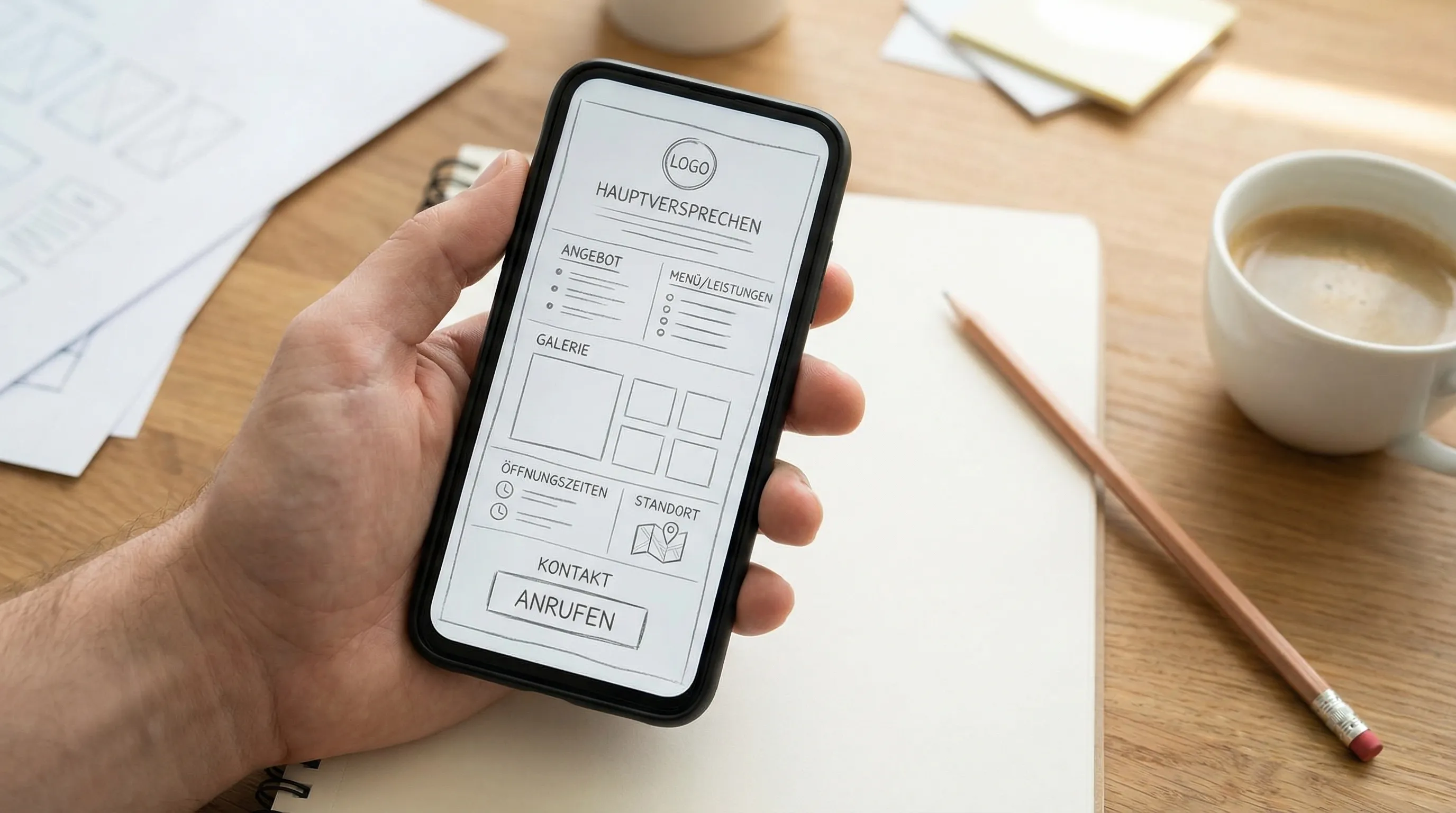
A website doesn’t always need ten subpages to bring in new guests, inquiries, or reservations. For many local businesses, a one page website is exactly the pragmatic approach: quick to launch, clearly structured, mobile-optimized, and reduced to the essentials.
The catch: A one page website isn’t worth it in every case. In this guide, I’ll show you when it really makes sense, where its limits are, and how to build it so it performs well in local search (Google) and with mobile visitors.
What Is a One Page Website (and What It Isn’t)?
A one page website bundles the most important content on a single page. Navigation typically works through anchor links (e.g., “Menu,” “Hours,” “Reservation”), not through separate subpages.
Important: One page doesn’t mean “little content,” but rather compact and goal-oriented. A good one page website answers the questions that really matter in everyday life:
- What do you offer?
- Where are you located?
- When are you open?
- How can customers contact you, make reservations, or place orders?
When a One Page Website Really Pays Off
A one page website is especially worthwhile when your goal is primarily conversion (calls, reservations, orders, inquiries) rather than a massive content archive.
1) You’re a Local Business with a Clear Offering
Restaurants, cafés, hair salons, studios, trades, or service providers with a clear offering benefit greatly: Most visitors come with a specific intent (checking the address, hours, viewing the menu, making a reservation).
When most of your business runs through a “main service,” one page is often ideal.
2) You Want to Go Online Quickly (Without a Months-Long Project)
Many SMBs lose time waiting for the “perfect” website. A one page website is often the best start because it can go live faster and you get feedback and real inquiries sooner.
Speed matters especially for new openings, seasonal businesses, or ownership changes.
3) You Need a Strong Mobile Experience
A lot of local searches happen on smartphones. One page sites can be especially well structured mobile-first: short sections, clear buttons (“Reserve now”), immediately visible information.
Google has been using mobile content as the basis for indexing for years (Mobile-First Indexing). A clean mobile site is therefore mandatory, whether one page or not.
4) You Want Clear Messages Instead of Complex Navigation
A one page website forces prioritization. This is an advantage if you:
- have one main offering
- want a simple customer journey
- want less distraction and more calls-to-action (CTAs)
5) You Have (Still) Little Content That Needs Separate Pages
If you don’t regularly need to explain blog articles, guides, job postings, or many services separately, one page can work long-term.
When a One Page Website Doesn’t Fit
One page isn’t a cure-all. There are scenarios where a classic multi-page website makes more strategic sense.
1) You Want to Rank for Many Different Keywords
If you offer very different services (e.g., an agency with 8 services) or want to optimize multiple locations separately, individual subpages often help with:
- clear keyword assignment
- clean internal structure
- more room for depth and examples
2) You Have a Lot of “Required Content”
With extensive content like:
- detailed service descriptions
- many references/case studies
- knowledge base, frequent updates
one page quickly becomes confusing or slow.
3) Your Page Gets Very Long and Unwieldy
A long one page can work, but at a certain point, user guidance suffers. If visitors have to scroll for 8 minutes instead of clicking to specific content, conversion often drops.
4) You’re Planning Strong Scaling (SEO Content, Campaigns, Recruiting)
If you know for sure that you’ll want to expand in 6 to 12 months, it may make sense to choose a structure that makes growth easier right away. Alternatively: Start with one page and plan an expansion early.
SEO: Is a One Page Website “Bad for Google”?
No, not universally. A one page website can rank well, especially locally. The fundamentals are what matter:
- clean technology (indexability, performance, mobile)
- clear structure (H1, H2, sections)
- local signals (address, service area, contact, possibly map)
- helpful content instead of just marketing fluff
What’s Often Harder with One Page SEO
One page has less “surface area” to cover many topics separately. So you have to prioritize more strictly and ask yourself: What search intent should this page fulfill?
For local businesses, the intent is often:
- “Restaurant nearby” plus map/hours
- “Reservation”
- “Menu”
- “Phone number”
If you cover these intents excellently, one page is absolutely competitive.
Performance Is a Real SEO and Conversion Lever
Fast loading times aren’t just pleasant—they also influence user behavior. Google measures page quality partly through Core Web Vitals.
If you want to check speed, use PageSpeed Insights.
One Page vs. Multi Page: A Quick Decision Guide
The question is rarely “What’s better?” but rather: What fits your goal and situation?
| Question | If you say “Yes,” this suggests… |
|---|---|
| Do you have a main offering that’s quickly understood? | One Page |
| Do you primarily need calls, reservations, or orders? | One Page |
| Do you want to market many different services separately? | Multi Page |
| Are you planning regular content (blog, news, guides)? | Multi Page |
| Is your most important traffic local and mobile? | One Page |
| Are there multiple locations with their own info? | Multi Page |
How a Good One Page Website Should Be Built (Practice)
A one page website is strong when it doesn’t feel like a “glued-together business card” but like a clear funnel.
Proven Section Order
For restaurants, cafés, and local businesses, this structure often works very well:
- Hero section: Who are you, what do you offer, plus primary CTA (e.g., “Reserve now”).
- Trust: Reviews, short USPs, awards, or “As seen in” (only if available).
- Offering/Menu/Services: short, scannable, with clear highlights.
- Gallery: Atmosphere, products, team, spaces.
- Hours and Location: prominent, not hidden.
- Reservation/Order/Contact: simple forms or direct integration.
- FAQ: reduces follow-up questions, increases conversion rate.
CTA Logic: Fewer but Clearer Actions
Many pages fail not because of design, but because of unclear direction. Define one main action and at most one or two secondary actions.
Examples:
- Restaurant: “Reserve” (main), “Order online” (secondary)
- Café: “Get directions” (main), “Hours” (secondary)
- Service provider: “Request quote” (main), “Call” (secondary)
Common Mistakes with One Page Websites (and How to Avoid Them)
Too Much Text Without Structure
One page needs “scannability”: short paragraphs, clear subheadings, meaningful anchor links.
Images Without Purpose
Beautiful photos help, but only if they inform: atmosphere, food, results, team, spaces. Avoid huge files that slow down the page.
Hours and Contact Too Far Down
In local searches, hours, phone number, and location are often the #1 reason for the visit. This information must be easy to find.
No Real SEO Foundation
One page SEO isn’t “a plugin.” Pay attention to:
- unique H1 (e.g., “Café in Zurich…”)
- H2 sections for offering, hours, contact
- descriptive meta data
- consistent local information (name, address, phone)
Cost and Effort: Why One Page Often Has the Best Price-Performance Ratio
For small businesses, three things usually matter: go live quickly, look professional, generate inquiries.
A one page website is often cheaper than a large project because:
- fewer pages need to be designed and coordinated
- the structure is ready faster
- content is created more focused
At Web Alpine Studio, you get a professionally implemented one-page website for restaurants, cafés, and local businesses in Switzerland for CHF 790 one-time plus CHF 29 per month hosting (including SSL, backups, updates, and one hour of changes per year), with mobile-first design, SEO optimization, fast loading times, and optional integrations like online booking or online ordering. If you need more room, a complete website with up to 10 subpages costs CHF 1’790. You’ll find all details on our pricing page.
Mini Checklist: Is One Page Right for You?
If you answer most of the following points with “Yes,” a one page website is very likely the right choice:
- My offering can be clearly explained in 5 to 10 sentences.
- My visitors primarily want to reserve, call, order, or visit.
- I don’t need 10 separate subpages.
- I want to go online quickly and expand later if needed.
- Mobile usage is central for me.
Frequently Asked Questions (FAQ)
Is a one page website professional enough for a restaurant or café?
Yes, if structure, content, performance, and mobile usability are right. For many guests, what matters is: quickly see the menu, make a reservation, check hours.
Can a one page website rank well on Google?
Yes, especially locally. Important are a clear page structure, fast loading time, mobile optimization, and strong local information (location, contact, offering).
How long should a one page website be?
As short as possible, as long as necessary. What matters is that visitors quickly find what they need and that the page stays clear on mobile.
What’s better: PDF menu or menu directly on the page?
A menu directly on the page is often more user-friendly (mobile, faster, searchable). A PDF can be useful as a supplement but shouldn’t be the only option.
Can I expand from one page to multiple pages later?
In many cases, yes. Often one page is a very good start, and as you grow, additional subpages for services, events, or SEO topics can be added.
Get a One Page Website That Brings Customers in Just Days
If you want a fast, mobile-friendly, and SEO-optimized one page website for your restaurant, café, or local business in Switzerland, Web Alpine Studio specializes in exactly that.
Check out our transparent packages on the pricing page, or contact us directly for a no-obligation consultation.